

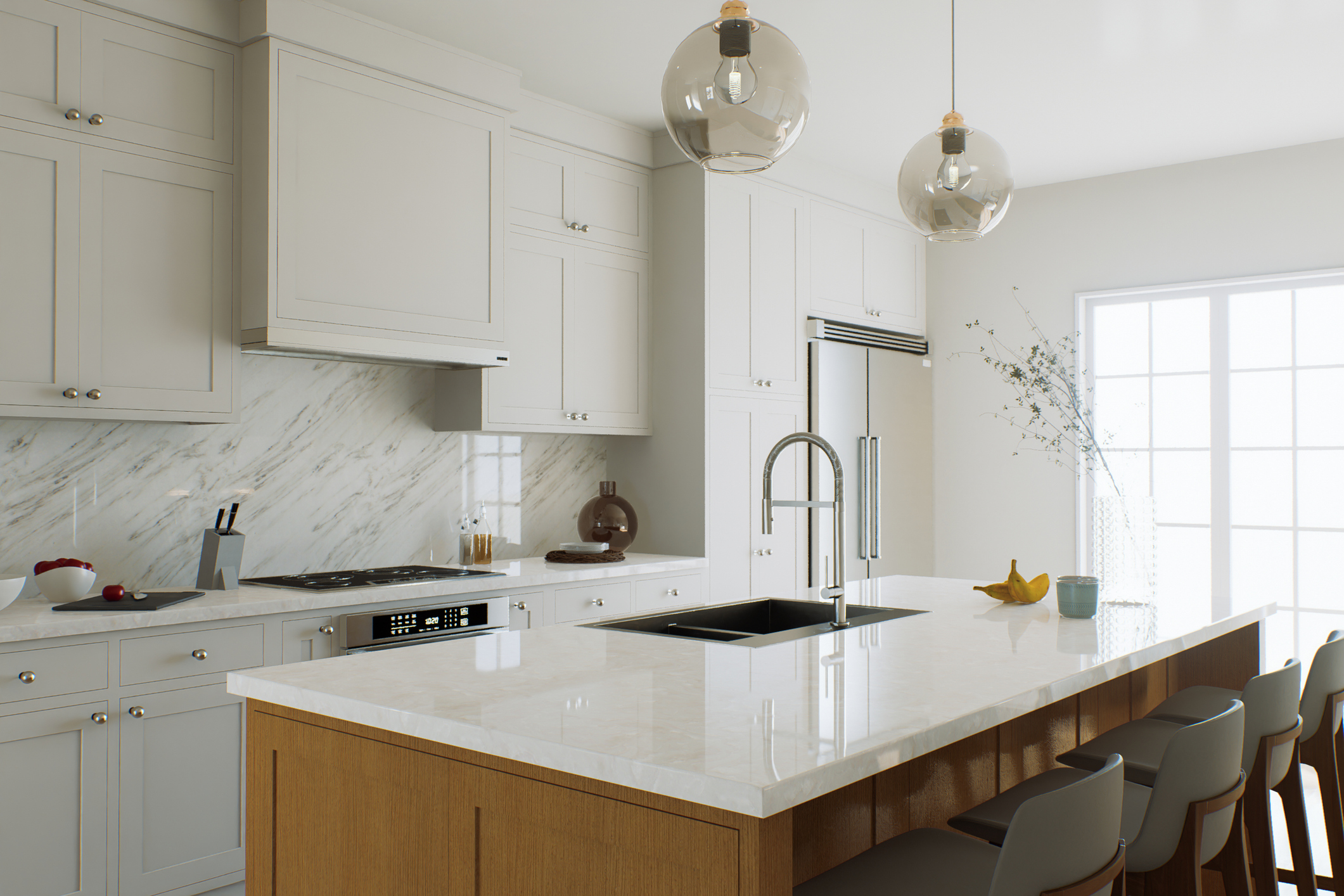
Two slabs are leaning against the wall in the Devonshire Street showroom. One is quarried stone, cut from a single block. The other was pressed in a factory from crushed quartz and resin. They can look almost identical under the lights, and homeowners in Chatsworth, Porter Ranch and Granada Hills routinely pick the wrong one for their kitchen because nobody explained the difference in plain terms.
So here it is. The choice comes down to how the material behaves at the seam, at the sink cutout and under a hot pan — not to which one photographs better. If you are planning a kitchen this autumn and want it finished before the holidays, the countertop decision is the one that has to happen early, because the cabinets have to be set before anyone can template.
Quick Summary: Key Takeaways
- Granite is quarried, quartz is engineered: one is a single natural slab, the other is roughly 90% ground quartz bound with resin and pigment.
- Quartz wins on consistency: no sealing, uniform pattern, and a seam that hides more easily because the colour repeats.
- Granite wins on heat: resin softens under a hot pan, and every quartz manufacturer says to use a trivet.
- Sealing is simpler than people fear: a granite top gets a wipe-on sealer periodically, and a water bead test tells you when.
- Cabinets come first: templating happens after the boxes are installed and level, so the cabinet order sets the whole schedule.
The difference is what the slab is made of, not how it looks on the sample
Granite comes out of the ground as one piece. Every slab is different, veining runs where it runs, and two slabs from the same bundle will not match perfectly. That variation is the entire appeal for some people and a dealbreaker for others.
Quartz is manufactured, typically around 90% ground natural quartz mixed with resin and pigment, then pressed and cured. Because it is made rather than found, the pattern repeats and the color is predictable from slab to slab — useful in a kitchen with a long run plus an island.
Pick up both. The engineered one usually feels warmer to the touch.
→ kitchen and bath countertops and cabinets
Seams, sink cutouts and edges decide how a countertop ages
A slab is only so big, so anything past roughly ten feet needs a seam, and an L-shaped Woodland Hills kitchen almost always has one. Where the fabricator puts it matters more than the material — behind the sink is the worst place.
Undermount sinks are where the two differ in the shop. Both take one fine. But the polished edge of the cutout is exposed forever, so granite wants a fabricator who keeps the veining running through the curve.
Edges are taste, mostly. Eased and square reads modern; bullnose reads 1998.
→ full kitchen remodeling in the San Fernando Valley
Sealing is the maintenance question homeowners actually ask
Quartz does not get sealed because the resin already closed the porosity. Granite does, usually with a wipe-on penetrating sealer, and the interval depends on the stone rather than on a calendar.
Test it yourself. Drop a tablespoon of water on the counter and wait fifteen minutes — if it beads, you are fine, and if it darkens the stone, it is time. That is the whole procedure, and it takes about twenty minutes to reseal a full kitchen.
Radon comes up occasionally, usually from something a neighbor read. The EPA’s position is that radiation from granite countertops is extremely unlikely to raise annual doses above normal background levels, and that soil under the house — not the counter — is the real source when a home tests high for radon.
The cabinets have to be right before anyone measures the stone
Templating happens on installed, level cabinets. Not on drawings, not on old boxes that will be replaced next week. That order of operations is why the countertop conversation belongs at the start of the project even though the stone arrives near the end.
We build the kitchen around solid-wood cabinetry, starting at $8,950 for a full set, and we do not reface. Refacing puts a new door on a 30-year-old particleboard box, and in a Valley kitchen that has already been through two decades of summer heat, that box is the part that failed.
New boxes. Then the template. Then the stone.
→ design, rendering and pricing
Valley kitchens bring their own constraints to the slab
Many of the kitchens we work in around Chatsworth, Granada Hills and West Hills came out of 1960s and 1970s tract construction — galley layouts, a soffit above the wall cabinets, a window over the sink.
Those rooms usually gain more from opening a wall and reworking the run than from an expensive stone. And light matters here in a way it does not everywhere: a dark absolute-black granite in a north-facing Porter Ranch kitchen with one window will read as a hole in the room, while the same slab in a Simi Valley kitchen with a skylight looks superb.
Bring a photo of the room. It saves a lot of guessing.
→ kitchen remodeling in Chatsworth and the Valley
How the quote comes together
A countertop price is square footage plus edge detail plus cutouts plus fabrication and install. Yards price by grade, so two granites that look alike can sit a long way apart.
Elias Deukmajian has run this shop for over twenty years under California contractor licence #947147, and the consultation is free. We measure, we show you real slabs rather than three-inch samples, and we quote the cabinets and the tops together so there is one number for the kitchen.
Thousand Oaks, Simi Valley and Woodland Hills clients are welcome in the Chatsworth showroom.
Frequently Asked Questions
Q: Is quartz or granite better for a kitchen countertop?
A: Quartz for a busy family kitchen you want to stop thinking about — no sealing, consistent colour, easier seams. Granite when you want a one-of-a-kind slab and you cook enough that heat resistance matters. They fail in different ways.
Q: Do granite countertops need to be sealed every year?
A: Not necessarily. Denser granites can go several years, and porous ones want it more often. Use the fifteen-minute water test — if the water darkens the stone rather than beading, reseal. It is a wipe-on product and a single afternoon.
Q: Can you put a hot pan on a quartz countertop?
A: You should not. The resin binder softens and discolours with direct heat, and manufacturers void warranties over it. Granite handles a hot pan far better, though a trivet is still the cheaper habit on either surface.
Q: Do you have to replace cabinets to install new countertops?
A: Not always, but the boxes must be sound, level and able to carry the weight. If they are original to a 1970s Valley kitchen and already sagging, new stone on top is money spent on the wrong layer.
Come see real slabs before you decide
Bring your measurements and a photo of the kitchen and we will walk you through both materials with the cabinets they would sit on. The consultation costs nothing.
Kitchen Emporium — 21417 Devonshire St, Chatsworth, CA 91311
Website: kitchenemp.net