

WHOLESALE PRICING TO THE PUBLIC!
Solid Wood Cabinets In a Variety of Colors & Styles Starting at $8,950
CA Licensed Contractor #947147


Two kitchens can use the same white cabinet and look nothing alike. The difference is the door — its profile, and how much of the frame it covers. Kitchen Emporium’s doors come in three families: contemporary, transitional and traditional. Most homeowners walk into the Chatsworth showroom with a photo on their phone and no words for what they’re pointing at. Shaker, slab, raised panel, inset. Each one behaves differently once you’re cooking in the room, and the wrong pick is expensive to undo. Hold two samples side by side on Devonshire Street before you sign anything.
Quick Takeaways
- Shaker is a flat panel recessed in a five-piece frame — the choice least likely to date your kitchen.
- Slab is one flat plane and wipes clean in a pass; dark and gloss finishes show every fingerprint.
- Inset sits flush inside the frame, costs the most to build, and moves with humidity.
- Full overlay leaves a thin reveal and reads modern; partial overlay shows frame and reads traditional.
Shaker earns its reputation, and what it costs you in cleaning
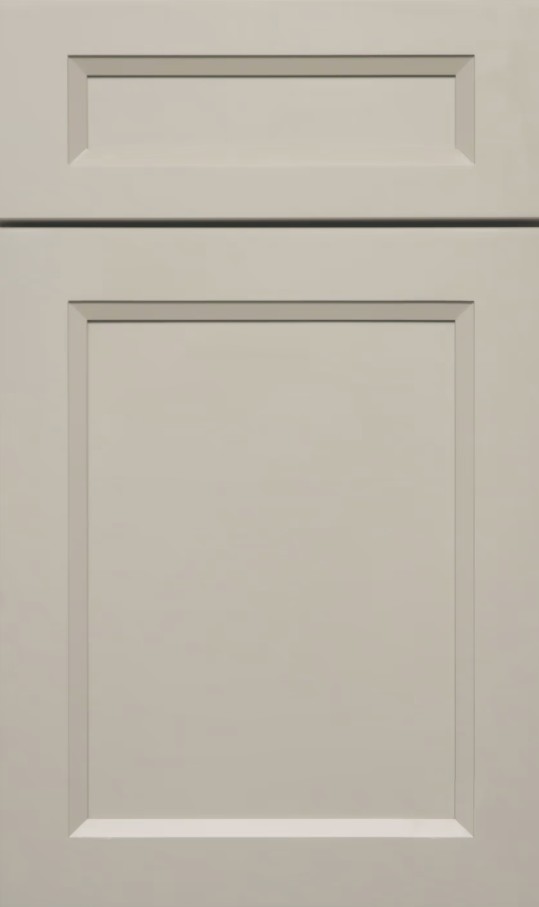
Shaker is a flat panel recessed inside a five-piece frame. That’s the whole design. It’s the safest choice here, and the reason is boring: it reads current in a 1965 ranch and a 2005 tract house alike, so it dates slower than anything else. White Shaker, Grey Shaker and Java Coffee Shaker are the three in our kitchen range.
There is one real cost. The panel sits below the rails, so the bottom rail forms a flat ledge that catches dust and cooking grease. In a family kitchen you will wipe it. A damp cloth along that rail every couple of weeks, more often if someone in the house fries.
Slab doors are the easiest thing in the kitchen to wipe down
A slab door is one flat plane. Nothing to catch. You wipe it corner to corner in a single pass, which is why slab suits newer construction, condos and anyone who cooks hard and cleans fast.
The trade is fingerprints. On a dark or high-gloss slab, every hand that opens the door leaves a mark, and in raking afternoon light through a west-facing Valley window you will see all of them at once. A matte finish forgives what gloss won’t. Want dark and low-maintenance? Go matte.
Raised panel and inset sit at opposite ends of the trouble scale
Raised panel carries traditional houses well. The center panel steps forward, and those shadow lines do real work — they hide the scuffs and door-edge wear that show up plainly on a flat white door. Glaze belongs here. Creme, Cinnamon, Mocha and Chocolate Glazed, plus Mahogany settle into the profile and read as depth instead of sitting flat on the surface. In a narrow galley, raised panel swallows the room.
Inset is the other extreme. The door sits flush inside the frame, which is beautiful and unforgiving; the box must be square and stable, and the door moves with humidity through the year. A reveal that looks right in February can bind in September. It’s the priciest door to build, and it isn’t the value play. For scale, the median U.S. kitchen remodel cost $8,000 between 2021 and 2023, according to the 2023 American Housing Survey.
Full overlay versus partial overlay changes more than the door does
Almost nobody asks about overlay. It decides the look anyway. Full overlay covers nearly the whole face frame and leaves a thin reveal between doors, so the run reads as continuous planes. Partial overlay leaves an inch or so of frame showing around each door, which breaks the run into separate pieces and reads traditional, closer to what most Valley kitchens were built with.
Same door, two different kitchens. A White Shaker in full overlay lands in the same visual neighborhood as a slab; the identical door in partial overlay reads like a careful 1970s remodel. Decide overlay before you decide finish. It costs nothing to change on paper and plenty to change after the order goes in.
Match the door to the house you actually own
Age matters. The San Fernando Valley’s median home was built in 1968, and 52.9% of its units went up before 1970, so most kitchens here sit inside trim and ceiling heights that were drawn a half-century ago. A 1968 ranch with original casing and a low ceiling will fight a heavy raised panel; Shaker or a soft transitional door sits with the trim instead of shouting over it.
Newer stock is a different call. A 1982 Porter Ranch two-story with tall boxes and open sightlines carries slab or full-overlay Shaker without looking cold. And a glazed door is the honest pick for a hard-working family kitchen, because glaze hides handprints a flat white shows within a year. Soft-close drawers and custom storage go on any of them.
STYLES




Testimonials
What Our Customers Say
Frequently Asked Questions
What is the difference between Shaker and slab cabinet doors?
Shaker has a flat panel recessed inside a five-piece frame, so you get a visible border and a small ledge along the bottom rail. A slab door is one uninterrupted plane, no frame and no ledge. Shaker reads transitional; slab reads modern.
Which cabinet door style is easiest to keep clean?
Slab, by a wide margin. One surface, one pass with a cloth. Shaker and raised panel both have a ledge or groove that traps dust and cooking grease, so plan on wiping the bottom rail if you cook most nights.
Is Shaker going out of style?
No sign of it. The shape is neutral enough to sit in a 1960s ranch and a new build without looking pinned to either, which is why it’s the door style least likely to date a kitchen before you sell.
What is the difference between full overlay and partial overlay cabinets?
Full overlay doors cover almost the entire face frame, leaving a thin reveal between them. That reads modern. Partial overlay leaves an inch or so of frame exposed around each door and reads traditional. One decision, whole-kitchen consequences.
Does the door style change the price of the complete kitchen?
Not within the standard range. The $8,950 complete kitchen covers 20 linear feet of solid-wood cabinets, your pick of ten quartz countertops, a 6-inch backsplash and an 18-gauge stainless sink, installed. Islands and layout changes are quoted separately.
Visit the Showroom or Book a Free Consultation
Photos flatten everything. Come stand two doors next to each other under real light at 21417 Devonshire Street in Chatsworth, at Devonshire and Canoga in the Ralphs plaza, Monday through Friday, 10 a.m. to 5 p.m. Or book the free in-home consultation: we measure your kitchen, bring samples to the house, and hand you a design rendering with itemized pricing. Family-run for over 25 years. CA Contractor License #947147.