

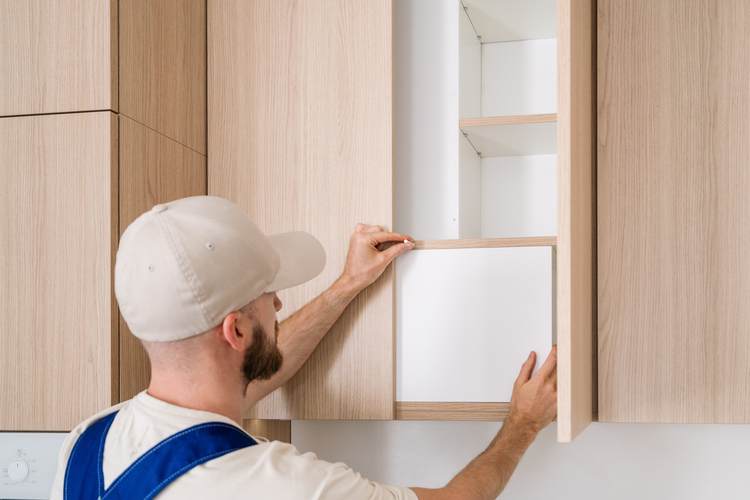
Open the cabinet beside your wall oven and look at the edge of the door. If it is peeling, curling, or showing a seam, that is thermofoil giving up after a decade of oven heat. Nobody warns you about that in a showroom.
Chatsworth kitchens push materials hard. Valley summers run past 100 degrees, dishwashers vent steam twice a day, and the difference between cabinets that last twelve years and cabinets that last thirty is usually decided before anything gets installed.
Quick Summary: Key Takeaways
- Two different parts: solid wood usually describes the door and face frame, while the box is plywood or particleboard, and the box decides lifespan.
- Heat kills thermofoil: doors next to an oven or dishwasher peel first, often somewhere between years eight and fifteen.
- Solid wood moves: real wood expands and contracts with humidity, so a thin line at a panel edge is normal, not a defect.
- Ask about the box: 3/4-inch plywood sides and dovetailed drawer boxes outlast stapled particleboard by decades.
- Run the math: our solid-wood kitchens start at $8,950, which reads differently once you price replacing laminate twice.
Solid wood and laminate describe two different parts of a cabinet
The words get used loosely, and that is where people lose money. Solid wood almost always means the door, the drawer front, and the face frame. Laminate, thermofoil and melamine are skins glued over a man-made core.
Both kinds still have a box. A cabinet can pair a lovely solid maple door with a stapled particleboard box and a printed paper interior, and that box will fail years before the door does.
So ask two questions. What is the door, and what is the box.
→ our cabinet styles and finishes
Laminate and thermofoil fail at the heat and the edges first
Watch the door beside the oven. Rigid thermofoil is a vinyl skin heat-pressed onto MDF, and steady heat is what breaks that bond, usually at the top edge nearest the oven.
High-pressure laminate holds up better than thermofoil, but it chips. Once an edge band lifts on a sink-base door, water gets into the MDF, the core swells, and you cannot sand your way out of it.
Repair is not really an option. Replacement is.
→ kitchen and bath remodeling FAQs
Solid-wood doors move with the seasons, and that is the trade-off
Real wood breathes. A five-piece solid oak or maple door expands slightly in humid weather and shrinks in a dry Chatsworth October, which is why a thin unfinished line sometimes appears at the edge of a center panel.
That is not a defect. It is the same movement that lets a solid-wood door be sanded, stained, and refinished twenty years from now. No thermofoil door can do that at any price.
Wood can be fixed. That is the whole argument.
→ finished kitchens in our gallery
The cabinet box decides lifespan more than the door style does
Spend your attention here. Three-quarter-inch plywood sides. Dovetailed solid-wood drawer boxes, full-extension soft-close slides, and a finished inside are the specs that split a thirty-year kitchen from a twelve-year one.
Air quality matters too: EPA formaldehyde standards cap emissions at 0.05 parts per million for hardwood plywood, 0.09 for particleboard, and 0.11 for MDF, so ask for compliant materials in writing.
Open a drawer in the showroom. Pull it all the way out and look at the corner joint.
Price the whole kitchen, not the door style
A door-by-door match-up always flatters laminate. Price the whole job instead: boxes, doors, hardware, countertop, demo, install, and the trim work that makes a 1970s Valley kitchen look square again.
Our solid-wood kitchens start at $8,950. That number does real work once you set it against buying laminate twice in thirty years and paying for demo and countertop removal both times.
Cheap twice is not cheap. Run the math.
How we spec cabinets for San Fernando Valley kitchens
Our showroom sits on Devonshire Street in Chatsworth, and most of the kitchens we build are within twenty minutes of it: Granada Hills, West Hills, Woodland Hills, Porter Ranch, Simi Valley, Thousand Oaks.
We sell cabinets, and we install them, which changes the advice you get. Twenty years of pulling out failed boxes in Valley houses is why we push solid-wood doors on plywood boxes, and why we talk people out of thermofoil beside a wall oven.
The consultation is free. We come to you, take the measurements, and price the job. Owner Elias Deukmajian holds California contractor license #947147.
→ affordable kitchen remodeling in Chatsworth
Frequently Asked Questions
Q: Are solid-wood kitchen cabinets worth the extra cost?
A: In a kitchen you plan to keep, yes. Solid-wood doors can be sanded, stained, and refinished decades later, while a damaged thermofoil or laminate door has to be replaced. Pair them with plywood boxes, and the kitchen usually outlives two laminate installs.
Q: How long do laminate or thermofoil cabinets last?
A: Often eight to fifteen years in a working kitchen, and the doors nearest heat and steam go first. High-pressure laminate outlasts thermofoil, but chipped edge bands still let water into the core, and that damage cannot be repaired.
Q: What should I look for in a kitchen cabinet box?
A: Three-quarter-inch plywood sides rather than particleboard, dovetailed solid-wood drawer boxes, full-extension soft-close undermount slides, a finished interior, and adjustable shelves with real pins. Pull a drawer out in the showroom and inspect the corner joint.
Q: Can you refinish laminate cabinet doors?
A: Not properly. There is no wood surface to sand, and paint on a vinyl or plastic skin rarely bonds for long. Refacing or replacing the doors is the honest fix, which is one more reason to buy solid wood the first time.
Start with a free in-home consultation
Show us the kitchen, and we will spec the boxes, the doors, and the countertop against how you actually cook. You will get a written price, not a per-door guess.
Kitchen Emporium — 21417 Devonshire St, Chatsworth, CA 91311
Hours: Mon–Fri 10:00am–5:00pm
Website: kitchenemp.net