

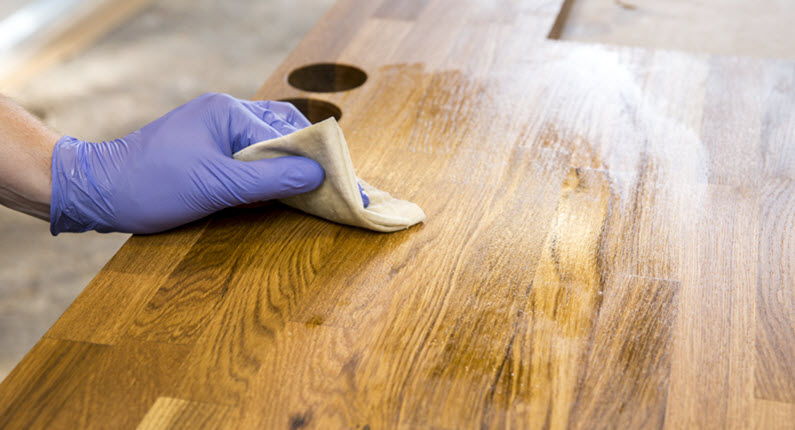
At times, many people opt for “stain-proof” countertops for their kitchen, trusting that they live up to their claims. However, with regular use, when these “stain-proof” countertops begin to stain, it comes as a shock to customers using them in their kitchens.
There is no doubt that certain countertop materials are very good at resisting stains; however, this doesn’t make them completely “stain-proof,” as the saying goes. In fact, certain factors can cause staining on these countertops. Our team of professionals at Kitchen Emporium, with years of experience, will share with you the common reasons for staining on these countertops and ways to fix them.
Reasons Behind Staining and Ways to Fix Them
Lack of Adequate Sealing
Most of the time, “stain-proof” countertops made of natural stones like granite or marble get stained over time because the factory sealant wears out with regular use. In fact, these materials are porous, contrary to popular belief, which allows liquid to seep into them as the sealant wears out.
You might often come across stains in the form of water rings, oil slicks, dark patches, and food and drink stains. Now you can test the seal’s effectiveness by pouring a small amount of water onto its surface. If the surface darkens or absorbs the fluid, you may need to reseal the countertop. In fact, you should reseal your countertop every 1-2 years and use a sealant designed for your countertop material. However, if your countertop is heavily stained, you must contact your kitchen contractor for cleaning and resealing.
Oil and Grease Stains
At times, grease from cooking can spill, and oil can accumulate on the countertop surface over the years. Over time, dirt and grime accumulate on the countertop surface, distorting its appearance.
In fact, the oil and grease stains are mostly visible around the cooking area as dark, greasy patches. One of the best ways to deal with the problem is by wiping your countertop regularly with mild dish soap and warm water, which helps remove grease and food particles.
In addition, you can opt for a degreasing cleaner specifically designed for countertops and compatible with the material used on your countertop. Nevertheless, when cleaning your countertop, avoid abrasive cleaners, as they can damage the surface.
Using Corrosive Chemical Cleaners
One of the biggest reasons “stain-proof” countertops get stained is the use of corrosive cleaners by people, which adversely affect the countertop surface. In most cases, using corrosive chemical cleaners like bleach, ammonia, or acidic cleaners damages the countertop sealant.
Now, due to the damaged countertop sealant, you might notice etching, discoloration, and a dull appearance on your countertops. That is why you will hear many professionals recommend using pH-neutral cleaners specifically designed for your countertop. Furthermore, you must thoroughly rinse your countertops with clean water after cleaning them to remove any remaining dirt and other contaminants.
Scratches and Erosion
Another leading reason “stain-proof” countertops get stained is scratches from knife use, abrasive cleaners, and rough objects, which can form cracks on the countertop surface and ultimately become areas for dirt and stains to gather.
If your countertop is getting stained from knife scratches, consider using cutting boards to help prevent further scratches. Moreover, if your surface has minor scratches, you must contact professional kitchen contractors to remove them, as taking on the repair work yourself can lead to additional damage to your “stain-proof” countertops.
Get in Touch With Us at Kitchen Emporium For Your Countertop Cleaning
We at Kitchen Emporium have years of experience serving customers in Chatsworth, CA, with high-quality countertops, and we also help them maintain their countertops. Whether it is just about your countertops or a complete kitchen renovation, we have got your back.
Call or contact us, and our professionals will be ready to answer all your queries.